
Key takeaways
- Malbec originated in France but found its ideal expression in Mendoza's high-altitude terroir, where altitude and aridity create wines with ripe fruit, smooth tannins, and balanced acidity.
- Argentine winemakers shifted Malbec from a blending grape to the nation's flagship varietal between the 1990s and 2010s, establishing it in global markets at all price levels.
- Argentine Malbec shows dark cherry and plum fruit with black pepper and chocolate spice, pairing excellently with grilled meat, beef, and hard cheeses.
Malbec did not start as Argentina’s grape. It arrived as a French import, planted in the 19th century alongside Cabernet Sauvignon and Syrah by European settlers who saw promise in Mendoza’s altitude and dry climate. For most of the 20th century, Malbec played a supporting role, a blending component in wines that led with other Bordeaux varieties. But over the past two decades, Malbec has become not just Argentina’s most recognizable export, but the wine that defined how the world understands Argentine terroir. This shift was neither accidental nor sudden. It emerged from the specific conditions of Argentine viticulture, the choices of winemakers who believed the grape’s potential was untapped, and a global market ready to embrace a wine that tasted fundamentally different from its French ancestor.
Malbec’s Origins and Identity
Malbec comes from Cahors, a region in southwest France where it has been the principal black grape for centuries. In Cahors, it is sometimes called Côt or Pressac, names that reflect regional traditions. The grape produces dark, structured wines with pronounced tannins and black fruit—plum, blackberry, and dark cherry—combined with notes of tobacco, leather, and mineral earth. In France, it remains a wine of power and austerity, suited to the cooler, wetter climate of the Lot Valley. The vine is vigorous and reliable, which made it valuable to 19th-century winemakers seeking consistent production, but it was rarely the star of the cellar. More often, it was the ballast in a blend, providing color and tannin structure while Cabernet Sauvignon took the lead.
Planting in Argentina
French agronomists and settlers brought Malbec vines to Argentina in the 1850s and 1860s, part of a broader transplantation of Bordeaux varieties intended to replicate European wine production in the New World. Mendoza Province, located east of the Andes at 2,000 to 3,500 feet elevation, seemed ideally positioned. The region receives only 8 to 10 inches of rain annually, requires irrigation, and benefits from stark temperature swings between hot days and cool nights. For over a century, Malbec grew quietly in this landscape, contributing to blended wines that rarely carried its name on the label. The wine industry that emerged was built on volume and on the assumption that Argentine wine would follow the European model: a supporting player in a portfolio designed for export markets that preferred French classifications and familiar blends.
Mendoza’s Terroir and Altitude Advantage
The turning point came when winemakers recognized that Mendoza’s specific conditions—elevation, sunlight, and aridity—offered Malbec something it could not easily achieve in Cahors or Bordeaux. High altitude slows ripening, extending the growing season and allowing the fruit to accumulate sugars and phenolic ripeness while preserving acidity. This created a wine with power but also balance: ripe dark fruit and smooth tannins without the overripe, heavy character that emerges when Malbec is grown in warmer, lower-elevation regions.
Luján de Cuyo and Maipú
Luján de Cuyo, located in central Mendoza at elevations between 2,600 and 3,300 feet, emerged as the premium Malbec zone. The region’s combination of alluvial soils, excellent drainage, and diurnal temperature variation proved ideal for the variety. Wines from Luján de Cuyo typically show deeper fruit concentration, finer tannin structure, and a clearer mineral character than those from lower elevations. Maipú, slightly lower and warmer, produces Malbec with riper, more voluptuous profiles. Both regions contributed to a new understanding of what Malbec could be: not a French wine transplanted, but a genuinely Argentine expression defined by its altitude home.
Climate and Vine Health
Mendoza’s dry climate also reduced disease pressure, allowing producers to manage vineyards with less chemical intervention and to harvest fully ripe fruit with confidence. The intense sunlight meant the vines could ripen Malbec grapes to full maturity in ways that were difficult or uncertain in cooler climates. This combination of reliability and excellence gradually shifted producer attention toward Malbec as a flagship grape rather than a blending component.
From Blending Grape to National Icon
The 1990s and 2000s marked a decisive change in Argentine wine production. Winemakers began releasing Malbec as a standalone varietal wine, bottled under its own name and marketed internationally. These wines arrived in a global market that was increasingly open to wines outside the classical European hierarchy. Early exporters like Alamos and Catena established Malbec in US retail channels at price points ($15–$25) that made them competitive with California Cabernet and accessible to everyday wine drinkers. These first-generation exports demonstrated that Argentine Malbec was neither a curiosity nor a poor imitation of French wine: it was a distinct, high-quality product with its own character.
As exports grew and critical attention followed, the wines climbed in quality and in price. By the 2010s, producers like Achaval Ferrero, Catena Zapata, and Familia Zuccardi were releasing reserve and ultra-premium Malbecs in the $40–$80 range, wines that competed directly with Napa Valley Cabernet and Bordeaux Right Bank Merlot. These bottles demonstrated that Malbec could achieve complexity and age-worthiness at the highest level. Malbec became the wine that represented Argentina internationally, the bottle that embodied Argentine terroir as surely as Riesling represents Germany or Nebbiolo represents Piedmont.
Tasting Profile and Regional Expression
Argentine Malbec varies by altitude, age, and producer style, but certain characteristics define the category. The fruit sits in the dark spectrum: plum, blackberry, and dark cherry dominate. Spice notes—black pepper, clove, and sometimes chocolate or leather—emerge from both the grape’s natural profile and oak aging. The tannins are typically smooth and integrated, less aggressive than Cabernet Sauvignon from the same region. Acidity is moderate, rarely sharp, and the wines are approachable young but built to age 5 to 10 years or longer depending on producer and vintage.
Altitude defines substyle. High-elevation Malbec (above 3,000 feet) shows brighter acidity, more mineral notes, and leaner body. Mid-elevation wines (2,500–3,000 feet) balance fruit-forward character with structure. Lower-elevation versions reveal warmer, riper profiles with less mineral lift and softer tannins. ABV typically ranges from 13 to 14.5 percent, lower than many warm-climate red wines and contributing to the wine’s drinkability.
Food Pairings and Use
Argentine Malbec’s moderate tannins, acidity, and alcohol make it versatile at the table. Grilled beef, barbecued meats, and empanadas are the canonical pairings, and for good reason: the wine’s smooth tannins and dark fruit complement charred, savory flavors without overwhelming the dish. Malbec also pairs well with hard and semi-hard cheeses, hearty stews, and chile-based dishes. The wine works as an everyday bottle with casual dinners and as a serious age-worthy wine for special occasions. It is equally at home in a steakhouse and at an informal family table.
Producers and Selection Guide
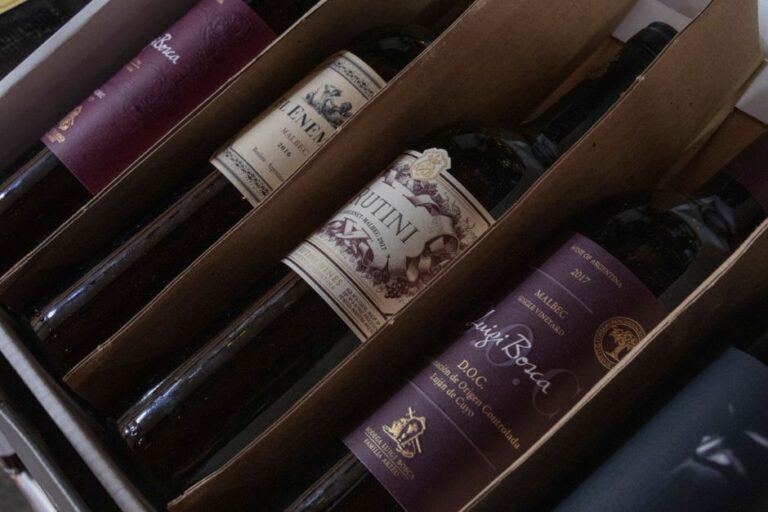
Entry-level Argentine Malbecs from large producers like Alamos, Finca Flichman, and Trapiche offer reliable, fruit-forward bottles in the $12–$18 range. Mid-tier options from Catena, Luigi Bosca, and Viña Maipo range from $20–$35 and provide more complexity and regional character. Premium producers like Achaval Ferrero, Familia Zuccardi, and Catena Zapata release single-vineyard and reserve bottlings at $40–$80 or higher. For cellar building, Malbec from top vintages in Luján de Cuyo—especially bottles with 5 to 8 years bottle age—offers age-worthiness and value compared to California or Bordeaux equivalents at similar price points.
Frequently Asked Questions
How is Argentine Malbec different from French Malbec?
Argentine Malbec from high-altitude Mendoza shows riper, softer tannins and darker fruit than French Cahors, which is more structured and austere. Argentine altitude extends the ripening season while preserving acidity, creating wines that are both powerful and balanced.
What is the best region in Argentina for Malbec?
Luján de Cuyo, located at 2,600 to 3,300 feet in Mendoza, is considered the premium Malbec region. Its elevation, drainage, and temperature variation produce wines with deep fruit, fine tannins, and mineral character.
How long can Argentine Malbec age?
Entry-level Malbecs are best within 3 to 5 years. Premium and reserve bottlings from top producers can age 10 to 15 years or longer, developing complexity and secondary flavors like leather and tobacco.
